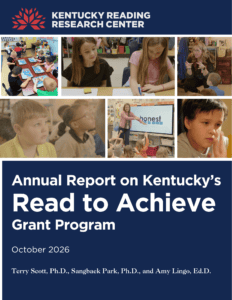
How are Kentucky schools using Read to Achieve (RTA) funding to support students who are reading below grade level? Our 2026 evaluation of the grant program provides a statewide picture of how schools are implementing the program, the resources they are using, and the conditions that help support effective literacy instruction.
The 2025–2026 evaluation, conducted for the Kentucky Department of Education, included a comprehensive survey of administrators, interventionists, and classroom teachers across 149 RTA schools in 53 districts. Our researchers also conducted direct observations and interviews in a sample of schools to gain a closer understanding of school-level literacy practices, collaboration, and instructional capacity.
The findings demonstrate that RTA schools are directing substantial resources toward literacy instruction staffing, administrators strongly value specialized interventionists, and educators report high confidence in foundational literacy practices. At the same time, the evaluation identifies opportunities to strengthen the systems that support teachers and interventionists in their daily work.
Among the key findings:
- Schools are investing in literacy instruction staffing. School administrators allocate 80.8% of RTA grant funds directly to RTA teacher salaries. In addition, 84.5% of schools supplement those funds through Title I and General Funds to sustain reading personnel. Administrators also recognize the importance of specialized interventionists. Nearly all surveyed administrators (95.3%) agreed or strongly agreed that interventionists have a vital impact on building literacy capacity. These findings underscore the connection between grant funding and the personnel responsible for supporting students with reading difficulties.
- Educators report confidence in foundational reading practices. Interventionists reported confidence levels of 90.4% in phonics and 88.4% in phonemic awareness. Classroom teachers also reported confidence in these areas, at 66.8% and 62.4%, respectively. Schools are also moving quickly to begin intervention. Nearly nine in 10 interventionists (87.1%) reported initiating formal instruction within four weeks of the start of the school year. However, confidence was considerably lower in specialized areas such as dyslexia and severe language disorders. Only 12.4% of interventionists and 6.1% of classroom teachers reported confidence in specialized dyslexia strategies. Confidence in strategies for severe language disorders was even lower.
- Educators value direct, interactive instruction. Educators consistently identified approaches that emphasize direct interaction between teachers and students as having the greatest impact. Teacher-guided phonics blending received a 95.3% impact rating, followed by explicit introduction of concepts (94.2%) and pre-teaching key vocabulary (93.3%). Educators also placed high value on additional instructional time (91.8%) and having more literacy teachers available (91.1%). Schools are also using high-quality instructional resources (HQIRs). Four resources account for more than 80% of the HQIRs reported across RTA schools. The evaluation also identified an opportunity to expand professional learning for paraprofessionals, who play an important role in supporting students receiving reading intervention. Although 41.3% of paraprofessionals support reading caseloads of substantial size, 61.6% have not participated in publisher-led HQIR professional learning.
- Collaboration is strong, but opportunities for feedback are less consistent. School literacy teams reported strong foundations for collaboration, including shared expectations, clear outcomes, and evidence-based practices. More than 95% reported strong agreement around shared agreements (96.1%), maintaining an inquiry stance (96.2%), and using evidence effectively (95.8%). Educators also reported high levels of relational trust and leadership support for collaboration. However, opportunities for educators to learn from one another and receive feedback on instruction are less consistent. More than half of teachers reported that coaching occurs less than once a month. Only 35.2% reported receiving a substantial amount of science of reading feedback during administrative evaluations. Peer observation was also one of the least-established collaborative practices.
- Time and student behavior remain significant challenges. Time was the most frequently reported barrier to effective literacy instruction, identified by 45.5% of classroom teachers and 25.9% of interventionists. Student behavior was another significant challenge, cited by 41% of teachers. Fewer than half of teachers reported feeling well prepared to address student behavior, and some reported receiving little or no training in this area.
Key takeaways
The evaluation findings as a while suggest that RTA grant funding fosters strong administrative support, meaningful investment in literacy instruction staffing, and confidence in foundational reading practices. They also identify opportunities to strengthen the systems that support educators every day.
Several areas warrant continued attention:
- Maintaining stable, multi-year grant funding to support literacy personnel.
- Expanding professional learning opportunities for paraprofessionals.
- Providing specialized literacy professional development to address intensive student needs.
- Protecting collaborative and instructional time.
- Strengthening administrator walkthroughs, instructional feedback, and opportunities for peer learning.
The findings offer state and local education leaders valuable information as they consider how to sustain and improve literacy interventions—and how to ensure Kentucky students receive the instruction and support they need to become successful readers.